
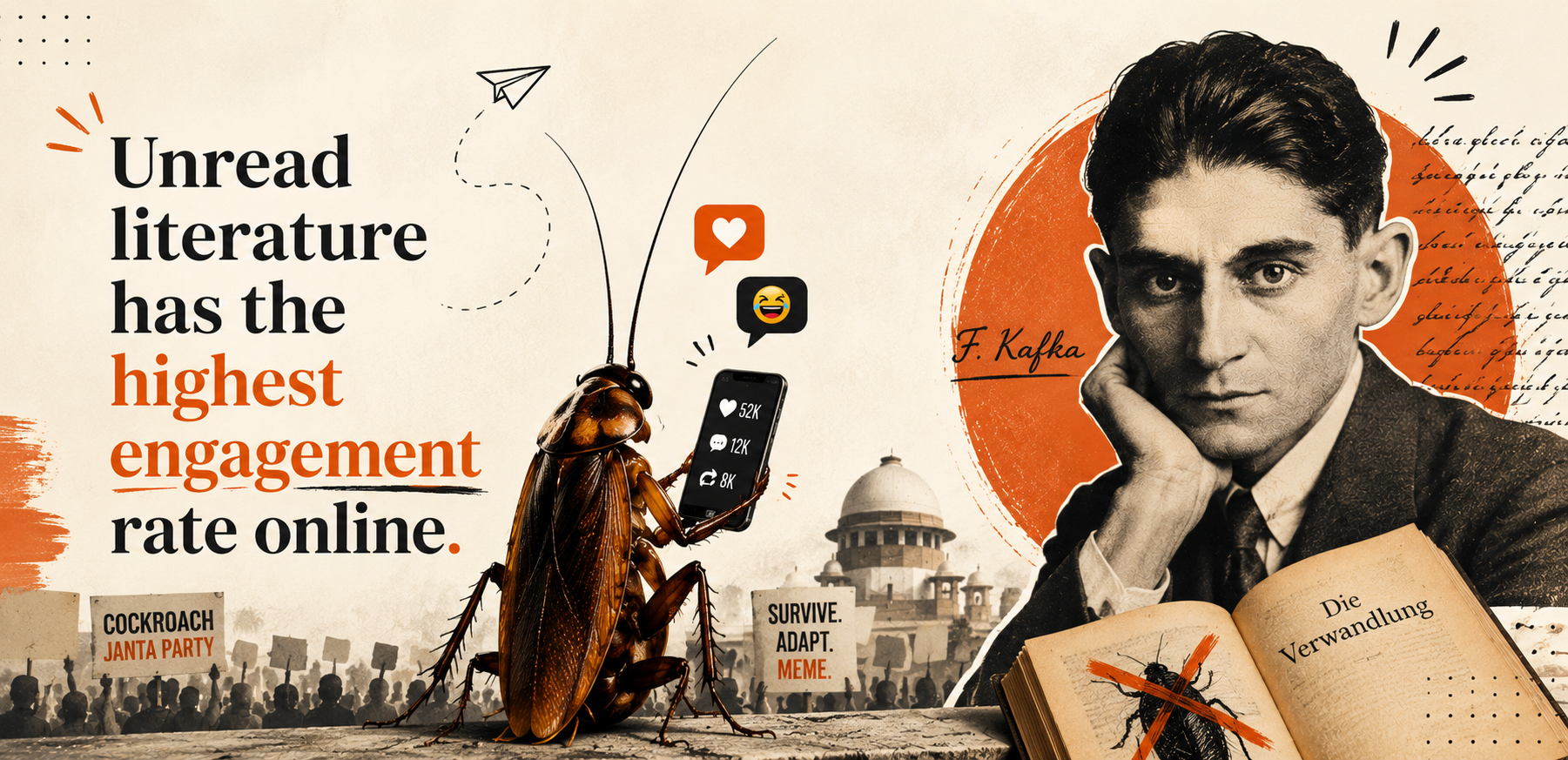
The internet cannot tolerate ambiguity for longer than forty-eight hours.
Franz Kafka left the creature in The Metamorphosis deliberately unnamed. Social media identified the species by lunchtime.
Which is why Kafka is suddenly trending alongside cockroaches in India.
The immediate reason, of course, is the rise of the Cockroach Janta Party — a satirical internet movement born after controversial judicial remarks comparing certain people attacking institutions to “cockroaches” and “parasites.” Within hours, the internet responded the way it always does: by converting insult into content.
Soon, Instagram pages were posting cockroach recruitment forms, fake manifesto graphics, slogans about “professional ranting,” and AI-generated campaign posters featuring insect revolutionaries demanding dignity for the chronically online and economically exhausted.
The Cockroach Janta Party sounded ridiculous at first.
That was precisely why it worked.
Modern internet culture has developed a strange instinct for turning humiliation into identity. The meme arrives before the ideology. Irony becomes community. Community becomes emotional shorthand. By the time everyone realizes a joke is carrying genuine social frustration underneath it, the symbol has already escaped containment.
The cockroach turned out to be a surprisingly effective mascot for the current political mood.
Not heroic. Not revolutionary. Just difficult to eliminate.
The creature survives hostile systems, adapts to decay, and continues existing long after cleaner and more respectable structures collapse around it. For a generation fluent in burnout, unemployment anxiety, institutional distrust, and permanent online exhaustion, the metaphor felt uncomfortably accurate.
Naturally, Kafka entered the discourse almost immediately.
Social media remembers literature through fragments. Dostoevsky becomes “suffering.” Orwell becomes “surveillance.” Camus becomes “existentialism for people holding cigarettes in profile pictures.” Kafka, meanwhile, survives online primarily as “the guy who wrote about a man turning into a cockroach.”
Except Kafka never actually wrote that.
In The Metamorphosis, Gregor Samsa wakes up transformed into what Kafka calls Ungeziefer — a word deliberately resistant to precision. Vermin. Pest. Unclean creature. Something socially contaminating. Kafka cared enough about this ambiguity to explicitly instruct publishers not to illustrate the insect on the cover.
He understood exactly what would happen if readers focused too much on identifying the creature.
A century later, people are still trying to solve the insect while reenacting the alienation.
Because Kafka cared far less about the biology of the creature than the social atmosphere surrounding it.
Gregor Samsa’s tragedy begins the moment everyone around him slowly stops recognizing him as fully human. Affection becomes conditional. Care turns reluctant. Conversations happen around him instead of with him. His existence begins to be measured entirely by usefulness. Kafka understood that alienation rarely arrives dramatically. It enters quietly — through embarrassment, impatience, closed doors, lowered voices, and the gradual feeling that one’s presence has become inconvenient to others.
The exact species was never really the point.
And yet the internet keeps returning to the insect.
Maybe that is inevitable in an online culture built around simplification. Ambiguity performs poorly on social media. Metaphor must become mascot. Literature must become shorthand. A psychologically dense meditation on shame and social abandonment eventually collapses into: “cockroach book.”
The strange irony is that while the internet misunderstands Kafka literally, it understands him emotionally with disturbing accuracy.
The Cockroach Janta Party works because people immediately recognize the emotional logic behind the metaphor. The cockroach represents social disgust, invisibility, persistence, and survival inside systems that no longer feel humane. Beneath the satire sits something genuine: exhaustion.
In another era, political movements chose symbols of aspiration.
This one chose the creature people instinctively try to crush.
Which may be the most revealing political image of the internet age.
After all, the internet responded to being compared to cockroaches by building posters, slogans, communities, and identities around the insult. People laughed, participated, reposted, and recognized themselves inside the metaphor almost immediately.
Kafka would probably have found that horrifying.
He also would have understood it perfectly.

