
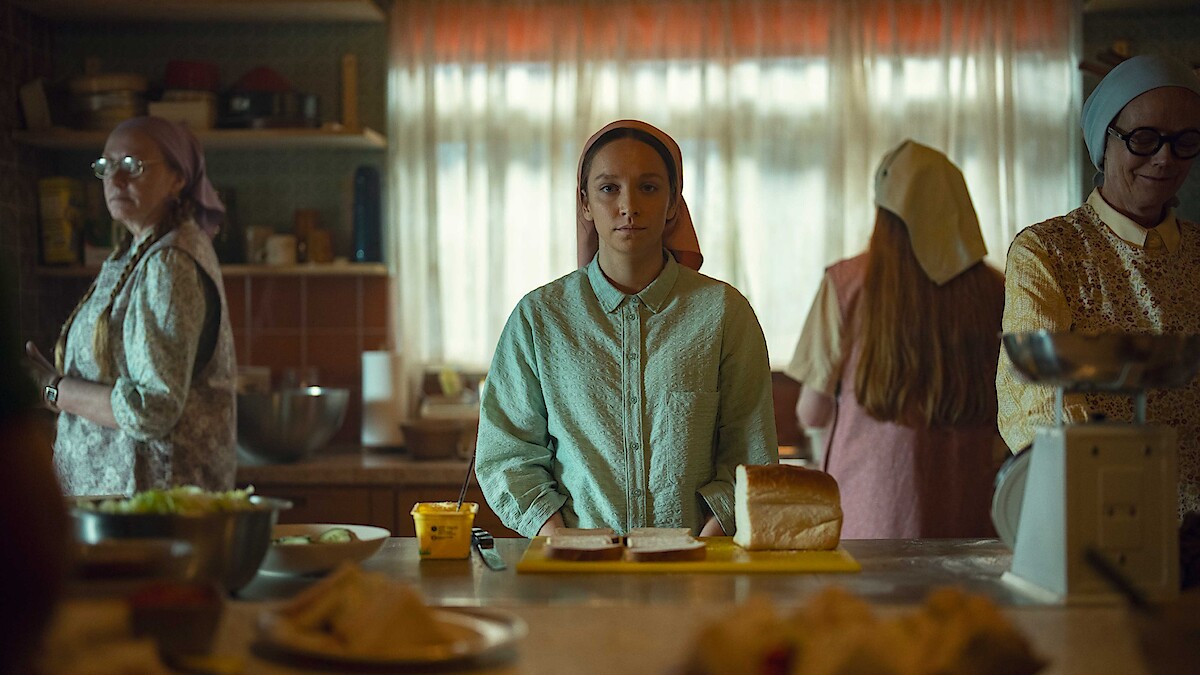
I chose to watch Unchosen on a whim—one of those quiet, instinctive decisions shaped by a few seconds of a Netflix preview and a gut feeling that this might be something different. The summary hinted at a secluded religious community, rigid gender roles, and a life governed by doctrine rather than independent thought or desire.
That alone was enough to pull me in. There’s something undeniably compelling about stories that explore insular worlds—places where time feels suspended and belief systems are so tightly woven into daily life that questioning them feels almost impossible.
What I didn’t expect was just how immersive the series would be. Across its six episodes, Unchosen unfolds through stark, restrained visuals—muted palettes, sparse interiors, and a quiet that feels almost suffocating. The pacing is slow but intentional, letting routine and ritual do as much storytelling as dialogue. I found myself stepping away only when absolutely necessary, pulled right back in each time.
The plot fades, but the undercurrent lingers—one that feels eerily aligned with today’s “trad wife” culture.
At its core, Unchosen presents a world where hierarchy is not just accepted but sanctified. Men are positioned as leaders and moral authorities; women are expected to follow, to listen, to embody obedience as virtue. Within the community, this isn’t framed as oppression—it’s framed as order, a kind of “chosen-ness.”
Watching this play out, it becomes difficult not to draw parallels to the modern resurgence of “traditional wife” ideals online. On the surface, the two seem worlds apart—one a closed, doctrine-driven environment, the other a curated, aesthetic lifestyle. But underneath, the structure of power feels strikingly similar.
What the show does particularly well is reveal how deeply this dynamic can be internalized. Rosie, for instance, is so conditioned to defer to male authority that even moments of apparent freedom don’t quite free her. During an outing beyond the community with her “unchosen” lover, something as small as lip gloss becomes telling—she wipes it off the moment he objects. It’s a fleeting gesture, but it says everything. Even Sam, who enters her life as a kind of escape, replicates the same control. The setting shifts; the dynamic doesn’t.
That’s what makes the comparison to real-world accounts like Tia Levings’ so unsettling. In her memoir A Well-Trained Wife: My Escape from Christian Patriarchy, Levings describes being shaped into the ideal of a “submissive wife” within a fundamentalist framework—where obedience is virtue and suffering is reframed as spiritual duty. What’s striking is how invisible that loss of autonomy can feel from the inside. Her life appeared structured, disciplined, even ideal from the outside, while internally her choices narrowed and her voice diminished.
This is where the “trad wife” internet culture becomes more complicated. Online, it’s not just an idea—it’s a product. Carefully framed videos of home-cooked meals, spotless kitchens, soft-spoken devotion—often paired with language around “choosing femininity” or “returning to traditional values.” It’s aesthetic, but it’s also monetized. And when that framing goes unquestioned, it can quietly reinforce the same imbalances it claims to soften. Stories like Levings’ remind us how easily those ideals, when followed uncritically, can reinforce the same imbalances Unchosen lays bare. The difference isn’t always in the structure itself, but in how visible its consequences are.
Unchosen strips away that aesthetic layer. There’s no softness here—only the mechanics of a system where obedience is normalized, identity is externally defined, and choice becomes increasingly constrained.
This isn’t to say that traditional roles are inherently harmful, or that people who embrace them lack agency. The real question is whether those roles are truly chosen—or shaped by pressures so ingrained they feel natural.
As a woman, I find myself sitting with the complexity of this. There’s genuine comfort—and even joy in soothing my toddler, cooking for my family, and creating a sense of home. These aren’t empty or imposed acts; they’re deeply meaningful to me. But I don’t see them as acts of submission, and I resist any framework that tries to define them that way. The tension isn’t in the roles themselves, but in who defines them—and whether stepping outside them is truly an option. For me, the line is simple: care should never come at the cost of autonomy.
Care, nurturing, domesticity—none of these should automatically translate into submission. I don’t see these choices as evidence of belonging under someone’s authority, nor do I want them to be. The line, for me, lies in agency: in whether these roles are freely inhabited, or quietly expected and enforced.
There’s also a reason these systems endure. The sense of belonging, the clarity, the relief of not having to question everything—it can be deeply comforting. Certainty is powerful.
But the show keeps returning to one quiet question: at what cost?
By the final episode, what stayed with me wasn’t just the story, but the quiet persistence of its patterns—the way control can feel normal, even comforting, when it’s all you’ve known. That’s what Unchosen understands so well. It doesn’t just show a closed world; it shows how easily its logic can echo beyond it. And that’s what makes it difficult to shake.
Header: via netflix.com

